Roger Sanders
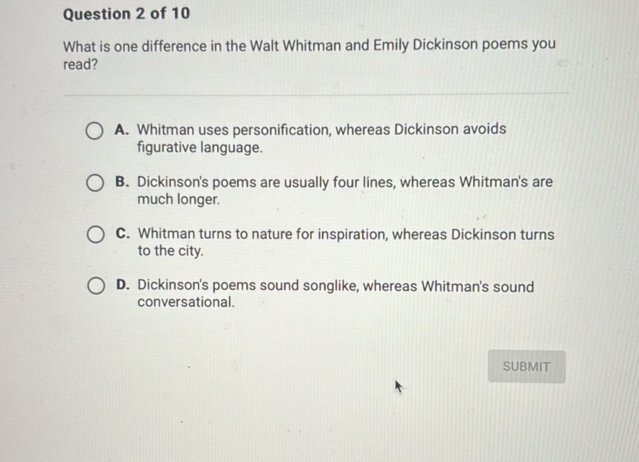
In the Walt Whitman and Emily Dickinson poems I read, one striking difference emerged: their distinct writing styles. Whitman embraced free verse and expansive lines, celebrating democracy and individualism. Meanwhile, Dickinson’s concise, introspective poems delved into themes of death and nature with rich imagery. While Whitman’s work pulsates with exuberance, Dickinson’s poems whisper with introspection, creating a fascinating dichotomy. Exploring these contrasting styles sheds light on how two literary giants uniquely contributed to the tapestry of American poetry.

Exploring the Difference in Walt Whitman and Emily Dickinson Poems
Welcome, young readers! Today, let’s delve into the fascinating world of poetry and discover the unique differences between two of the most renowned poets in American literary history: Walt Whitman and Emily Dickinson. Both Whitman and Dickinson made significant contributions to poetry, but their styles and themes differ in many intriguing ways. So, what is one key difference in the poems of Walt Whitman and Emily Dickinson that we have read?
Their Perspectives on Nature
One striking difference between Whitman and Dickinson’s poems is their perspectives on nature. Let’s take a closer look at how each poet portrays the natural world in their works.
Walt Whitman’s Celebration of Nature
Walt Whitman, often referred to as the “Bard of Democracy,” had a profound love for nature, which is evident in many of his poems. Whitman’s poems are filled with vivid descriptions of the beauty of the natural world – from the grandeur of the forests to the serenity of the rivers. He celebrates the interconnectedness of all living beings and often uses nature as a metaphor for deeper human experiences.
In Whitman’s poem “Song of Myself,” he writes:
“I believe a leaf of grass is no less than the journey-work of the stars.”
This line reflects Whitman’s belief in the equality and importance of all aspects of nature, from the smallest blade of grass to the vast expanse of the cosmos.
Emily Dickinson’s Unique Approach to Nature
On the other hand, Emily Dickinson, known for her introspective and enigmatic poetry, had a more intimate and personal relationship with nature in her works. Dickinson’s poems often explore the connection between the natural world and the human psyche, delving into themes of mortality, solitude, and the passage of time.
In her poem “A Bird Came Down the Walk,” Dickinson writes:
“A bird came down the walk:
He did not know I saw;”
This simple yet profound observation captures Dickinson’s keen eye for detail and her ability to find deeper meaning in everyday moments with nature.
Writing Style and Form
Another key difference between Whitman and Dickinson’s poems lies in their distinct writing styles and forms. Let’s uncover how their approaches to poetic expression set them apart from each other.
Walt Whitman’s Free Verse and Epic Poetry
Walt Whitman is known for his groundbreaking use of free verse, a form of poetry that does not adhere to traditional rhyme or meter. Whitman’s poems often have a rhythmic and expansive quality, mirroring the breathless expanse of his poetic vision.
In his epic poem “Song of Myself,” Whitman embraces the free-flowing nature of free verse to capture the vastness of his themes and the inclusivity of his perspective. This form allows Whitman to break free from the constraints of conventional poetry and create a sense of freedom and open-endedness in his works.
Emily Dickinson’s Concise and Poignant Verses
Unlike Whitman’s free verse style, Emily Dickinson’s poetry follows a more structured and concise form. Dickinson’s poems are characterized by their short lines, compact stanzas, and often unconventional punctuation. Her use of dashes and capitalization adds a unique rhythm and emphasis to her verses.
One of Dickinson’s most famous poems, “Because I could not stop for Death,” exemplifies her distinctive style:
“Because I could not stop for Death –
He kindly stopped for me – ”
This succinct and impactful verse showcases Dickinson’s ability to convey profound emotions and complex ideas in just a few lines.
Themes and Subjects
While both Whitman and Dickinson explore a wide range of themes in their poetry, they each have their own distinct focus and subject matter. Let’s explore how their themes diverge and converge in their works.
Whitman’s Themes of Democracy and Individualism
Walt Whitman’s poetry is deeply rooted in the themes of democracy, individualism, and the celebration of the human spirit. Whitman’s belief in the equality and interconnectedness of all people is a central theme in his works, as seen in poems like “I Hear America Singing” and “Leaves of Grass.”
Whitman’s poems often exude a sense of optimism and inclusivity, emphasizing the importance of embracing diversity and embracing one’s unique identity.
Dickinson’s Themes of Death, Love, and Isolation
Emily Dickinson, on the other hand, delves into themes of death, love, and isolation in her poetry. Dickinson’s exploration of mortality and the fleeting nature of life is a recurring motif in many of her works, reflecting her preoccupation with the mysteries of existence.
In poems like “I heard a Fly buzz—when I died—” and “Wild Nights – Wild Nights!,” Dickinson grapples with themes of love, loss, and the ephemeral nature of human connections.
As we’ve journeyed through the poems of Walt Whitman and Emily Dickinson, we’ve uncovered some fascinating differences in their styles, perspectives, and themes. While Whitman celebrates the vastness of nature and the diversity of human experience, Dickinson delves into the inner landscapes of the human soul with her poignant and introspective verse.
By exploring the works of these two iconic poets, we gain a deeper appreciation for the rich tapestry of American poetry and the diverse ways in which poets can express their unique voices and visions. So, young readers, the next time you encounter a poem by Whitman or Dickinson, remember to look closely at the details, listen to the rhythms, and feel the emotions that flow through their timeless words.
Happy reading, and may the magic of poetry continue to inspire and uplift your hearts and minds!
Emily Dickinson vs. Walt Whitman: Poems Comparison – Essay Example
Frequently Asked Questions
What aspects distinguish Walt Whitman’s poems from Emily Dickinson’s works?
One key difference between Walt Whitman and Emily Dickinson’s poems is their writing style and form. Whitman’s poetry is known for its free verse, expansive language, and long lines that reflect his celebration of individualism and the diversity of American life. On the other hand, Dickinson’s poems are characterized by their compactness, concise language, and use of slant or off-kilter rhymes. She often explored themes of death, immortality, and the human soul in her introspective and deeply personal poetry.
How do Walt Whitman and Emily Dickinson differ in their approach to nature in their poems?
While both poets were influenced by nature, they portrayed it in distinct ways. Walt Whitman’s depiction of nature tends to be grand, celebratory, and symbolic of the interconnectedness of all living things. His nature imagery often reflects his belief in the divine and his optimism about humanity’s potential. In contrast, Emily Dickinson’s treatment of nature is more introspective, focusing on its beauty, power, and its role in human emotions and experiences. She often used nature as a metaphor to explore complex inner landscapes and existential questions.
How do Walt Whitman and Emily Dickinson differ in their use of voice and persona in their poems?
Walt Whitman’s poems frequently feature a bold and inclusive voice that speaks in the first person plural, embodying the collective spirit of America. His persona is expansive, embracing all facets of society and expressing a sense of unity and democracy. In contrast, Emily Dickinson’s poems often present a more solitary and introspective voice, reflecting her personal struggles, doubts, and moments of revelation. Her persona is often enigmatic, exploring themes of isolation, longing, and transcendence in a more intimate and reflective manner.
Final Thoughts
In comparing Walt Whitman and Emily Dickinson’s poems, one notable difference is their perspectives on nature. Whitman celebrates nature’s grandeur and its interconnectedness with humanity. On the other hand, Dickinson focuses more on the intimate and personal connection to nature, often delving into themes of introspection and individual experience. This difference reflects their unique writing styles and worldviews. Despite their contrasting approaches, both poets continue to captivate readers with their profound and timeless works.